Three crypto thefts in two days took $3.71 million, according to DefiLlama's public hack database updated 14 November 2026. Why do such losses still start in calculations and permissions that ordinary users cannot see? The answer matters because the small cluster reveals a pattern behind a far larger yearly total.
- Frontend & Infrastructure6,50474%
- Key Compromise7228.2%
- Bridge & Cross-Chain7018.0%
- Access Control3714.2%
- Token & Share Accounting2542.9%
- Other2332.7%
The cluster is small beside the year's recorded total, yet its mechanics explain where the money goes when a single figure or approval goes wrong. DefiLlama's account traces the largest theft to a miscalculated supplier figure, the smallest to permissions already granted by users, and the third to trading agents whose scope remained unclear. Together they show risk concentrated in places a wallet screen never displays.
A supplier figure multiplied, then became borrowing power
According to DefiLlama's account, attackers used an arithmetic error in Kava Lend's BUSD market. The supplier interest figure, which tracks earnings owed to people who supplied funds, rose 243,000-fold because the effective supply behind it was extremely small. That inflated figure created collateral claims far larger than the real position justified.
Borrowing followed the inflated claims. The attackers repeatedly borrowed KAVA, then closed the loans through a process that erased the debt while leaving too little collateral behind, as DefiLlama's account describes it. The amount taken was 53.9 million KAVA.
Much of that KAVA moved to BNB Chain and was sold there, according to the same account. At the Relay bridge, 612,416 USDT linked to laundering was blocked. A bridge can therefore interrupt some proceeds after a theft, even though it cannot reverse borrowing inside the lending protocol.
Granted permissions opened the smaller doors
DefiLlama lists the Pennysia incident, dated 13 November, under Access Control, involving an arbitrary external call. Its account says an attacker used malicious tokens to pass spending checks, then drew on permissions users had already granted to move USDC, wstETH and YUNO from their wallets through the contract. The sum taken was $5,131, from four users on Ethereum.
| Project | Network | Taken | Type of attack |
|---|---|---|---|
| Kava Lend | Kava | $3.70 million | Token & Share Accounting |
| Pennysia | Ethereum | $5,131 | Access Control |
| Hyprearn Perps | Hyperliquid L1 | not recorded | Protocol Logic |
Hyprearn Perps, on Hyperliquid L1, had no amount recorded yet in the database. DefiLlama lists its type as Protocol Logic, meaning a flaw in the service's own rules. The team disclosed reports of unauthorized trading in a small number of Hyperliquid accounts that had earlier authorized its API agent wallets, according to the database account.
Its team revoked its existing trading agents on its side and told affected users to remove approvals directly through Hyperliquid before authorizing replacement agents. Those agents had trading permission without withdrawal permission. The account therefore links any financial impact to trading done without authorization, not to money taken straight from a wallet. The cause, the number of affected accounts and total losses remain undisclosed in the database.
One very large loss bends the yearly total
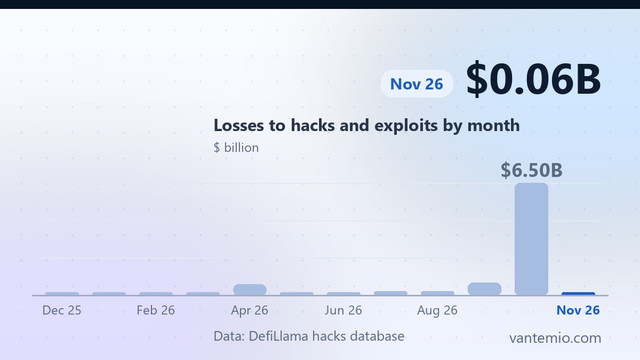
So far this year the database counts 347 incidents and about $8.79 billion taken where an amount is known. The same part of 2025 held 126 incidents and about $2.64 billion. More incidents occurred, and far more money was taken, yet the distribution matters more than either total alone.
Binance CEX, on 29 October, is the largest incident of 2026 so far, at about $6.36 billion, in the Frontend & Infrastructure category. That label points to the service's public-facing systems rather than the arithmetic inside a lending market. One incident therefore accounts for most of the year's recorded total.
Over the last thirty days to 14 November, the database records 45 incidents and about $6.44 billion. The thirty days before them hold 32 incidents and about $518.98 million. The sharp rise in money, against a modest rise in count, points to a small number of very large events driving the total, not a steady increase in everyday thefts.
What users can check before authorizing anything else
A wallet screen cannot show an interest index or an arithmetic error before it is used. It can show approvals already granted, the address a service asks a user to trust, and agent wallets holding trading permission. Hyprearn's advice points to that check: clear the earlier approval first, then grant a fresh one, instead of adding another layer of permission.
Pennysia narrows the point further. Users meant to exchange one token, while the account describes other tokens leaving their wallets under permissions granted earlier. Checking which tokens a contract may move, and for how much, matters as much as checking the trade itself.
Funds returned this year where the database records them stand at about $8.25 million. That figure sits far below the amount taken, so recovery remains the exception rather than the normal outcome. Future updates will show whether Hyprearn gains a recorded amount, whether Kava Lend recovers any funds, and whether the recent thirty-day total eases toward the earlier level or stays elevated.
That pattern is clear enough to act on. Losses in this cluster did not come from users sending money to the wrong address. They came from a miscalculated figure, from permissions granted in advance, and from trading agents left in place. Until services make those hidden controls visible, the safest step for a user is to treat every approval as a live risk and review it before the next trade.
Source: DefiLlama · Date: